
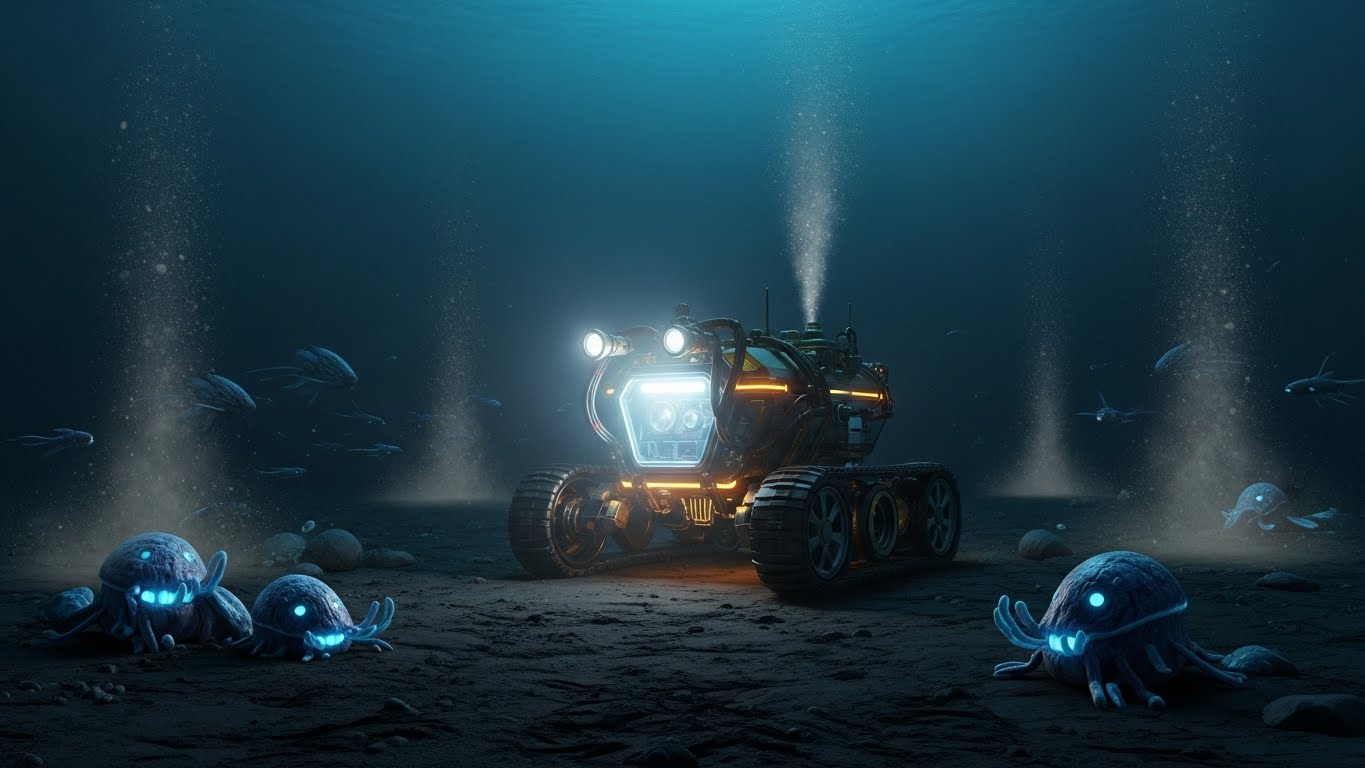
As the world races to phase out fossil fuels, a new hunger has emerged: the hunger for Rare Earth Elements (REEs) like cobalt, nickel, and manganese. With the recent 2026 discovery of massive mineral deposits in the Atlantic seabed, we face a critical “What If.” What if deep-sea mining becomes the new “Oil Rush” of the 21st century? This could accelerate the green energy transition but at the cost of destroying the last untouched frontier on Earth.
1. The Silent Treasure: Why the Seabed?
The deep ocean floor is littered with “polymetallic nodules”—potato-sized rocks that took millions of years to form. These nodules contain more high-grade minerals than all terrestrial mines combined.
- The EV Connection: To build millions of electric vehicle batteries, we need these minerals. Without them, the “Green Revolution” might stall.
- The Geopolitical Shift: Nations that control the seabed could become the “New OPEC” of the 21st century, shifting power away from traditional oil-rich nations.
2. The “What If” Scenario: The Industrialization of the Abyss
A. The Economic Boom: Trillions Under the Waves Imagine a world where the ocean floor is as busy as a Texas oil field.
- Falling Costs: If deep-sea mining becomes widespread, the cost of high-tech electronics and EVs could drop by 40-50%.
- New Job Markets: We would see the rise of “Sub-Aquatic Engineers” and robotic operators managing massive fleets of autonomous mining machines.
B. The Environmental Catastrophe: “Dark Extinction”
- Sediment Plumes: Mining machines stir up “dust clouds” that can travel for hundreds of miles, suffocating delicate deep-sea life that has never seen light or silt.
- Noise Pollution: The constant thrum of machines in the deep ocean could disrupt the communication of whales and dolphins, leading to a collapse of marine ecosystems.
- The “What If” of Carbon: What if disturbing the seabed releases massive amounts of sequestered carbon back into the ocean, actually accelerating climate change instead of fixing it?
C. The Legal Battle: Who Owns the Abyss?
- International Waters: Does the mineral wealth of the deep sea belong to all of humanity, or only to the companies with the tech to grab it?
- Sea-Level Conflict: Just like the South China Sea, we could see military standoffs over “Mining Zones” in international waters.
The Green Paradox
“In my opinion, deep-sea mining is the ultimate ‘Green Paradox.’ From TechWhatIf’s perspective, it feels ironic that we must destroy one of the most mysterious and fragile ecosystems on Earth just to build ‘clean’ energy for our cities. It’s like cutting down a forest to plant solar panels. I believe the real ‘What If’ we should be asking is: What if we focused on ‘Circular Economy’ and recycling current minerals instead of rushing to scar the ocean floor? We must be careful not to trade an oil crisis for a biodiversity crisis.”
Note: This is a speculative ‘What If’ analysis based on current 2026 economic trends and not financial or environmental advice. Deep-sea mining is currently subject to intense debate by the International Seabed Authority (ISA); stay tuned for legal updates.