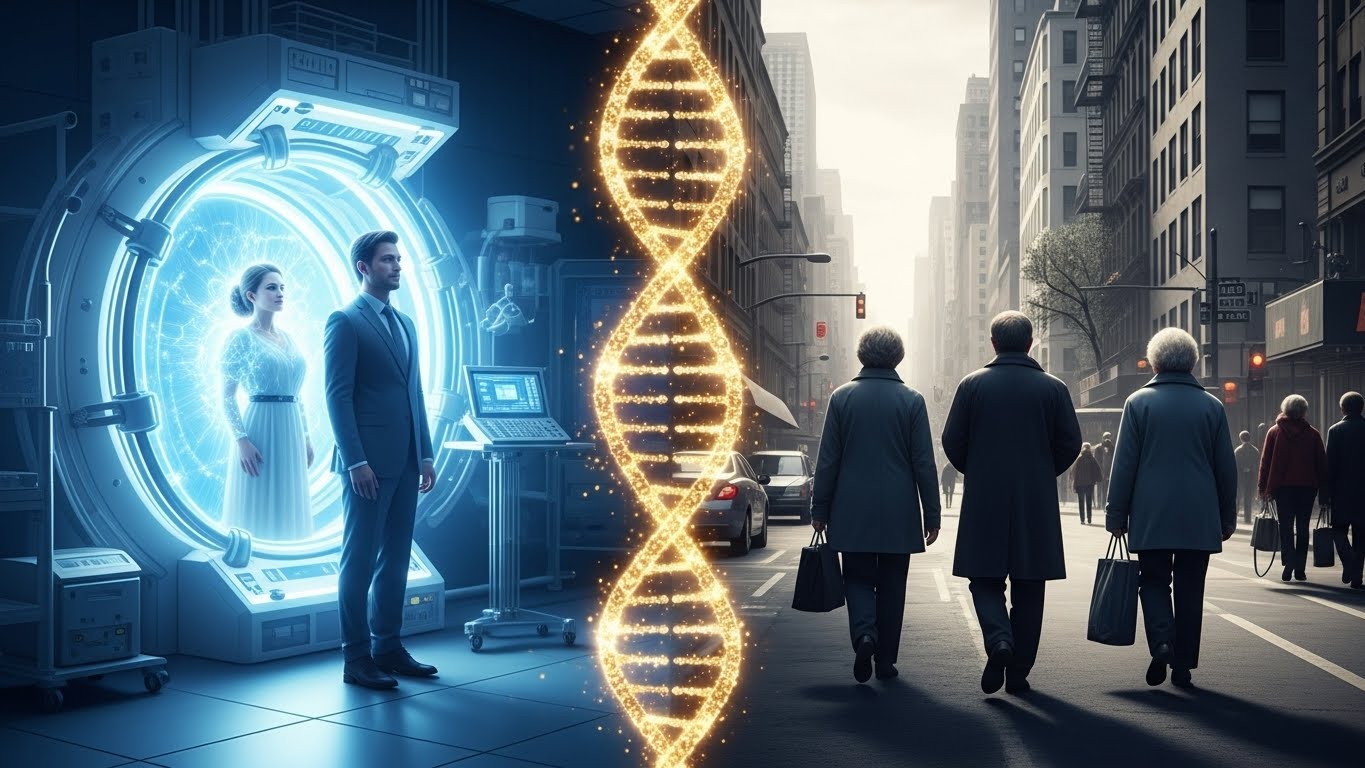
The quest for “Digital and Biological Immortality” is no longer fringe science. However, as breakthrough therapies like cellular reprogramming and senolytic drugs emerge by 2030, a terrifying “What If” manifests: What if these life-extending technologies are so expensive that they become the ultimate luxury good? This could lead to a permanent “Biological Class Divide,” where wealth buys not just comfort, but fundamentally different lifespans.
The Inequality of Time: Breaking the “Great Equalizer”
Time has always been the “Great Equalizer”—death eventually comes for everyone. But with billions invested in longevity startups by tech titans, the biological clock is being hacked. What if the rich can buy an extra 50 or 100 years of healthy life? This would transform wealth inequality into a permanent, biological reality. We are no longer talking about who has a faster car, but who has more decades to live.
The “What If” Scenario: A Two-Tiered Humanity
A. The Rise of “The Centenarian Elite” Imagine a corporate CEO who is 150 years old but has the physical vigor of a 30-year-old.
- Monopoly of Power: If the top 1% can live for centuries, they can accumulate wealth and political power indefinitely. The “Old Guard” would never retire, leaving no room for younger generations to lead.
- The Experience Gap: A biological elite with 200 years of knowledge would have an insurmountable advantage over those with “natural” lifespans.
B. The New Civil Rights: The “Right to Ageing” If lifespan is determined by your bank account, access to longevity tech would become the ultimate human rights battle.
- Longevity Loans: Would we see the rise of “Life Credits” or loans that trap families in debt for generations in exchange for an extra 20 years of life?
- The Ethical Dilemma: Is it moral to allow a child to die of “natural” causes at 80 while a billionaire’s child is programmed to live to 500?
C. Economic Stagnation: A World That Never Changes
- Innovation Stagnation: Social mobility depends on the turnover of generations. If the same people control resources for centuries, will new ideas ever flourish?
- The Silver Economy: Markets would shift entirely toward serving the ultra-long-lived, ignoring the needs of the “natural” population.
The Soul of Mortality
“In my opinion, the most dangerous part of longevity tech isn’t the science—it’s the ‘Biological Stagnation’ of our society. From TechWhatIf’s perspective, death provides a necessary refresh for human culture, art, and leadership. If the 1% becomes immortal, we risk living in a ‘Museum World’ where nothing ever changes because the owners of the world never leave. I believe we must fight for the ‘Democratization of Age’ as fiercely as we fought for the right to vote. Without it, we aren’t just creating a class divide; we are creating two different species.”
Technical Barriers and Hope for Democratization
While current therapies are expensive, some futurists argue that AI-driven discovery will eventually drive costs down, much like smartphones.
- The “Antibiotic Effect”: Just as penicillin was once rare but is now universal, longevity tech could become a public utility. But will it happen fast enough to prevent a social revolution?
Recommended Reading
As we merge biology with digital tech, our mental privacy is also at risk. Read our analysis on What If Neuralink Allows Us to “Upload” Memories? to see the other side of the Bio-Digital coin.
Note: This is a speculative ‘What If’ analysis and not medical or financial advice. Always perform your own research and consult with a professional before making any health or investment decisions.