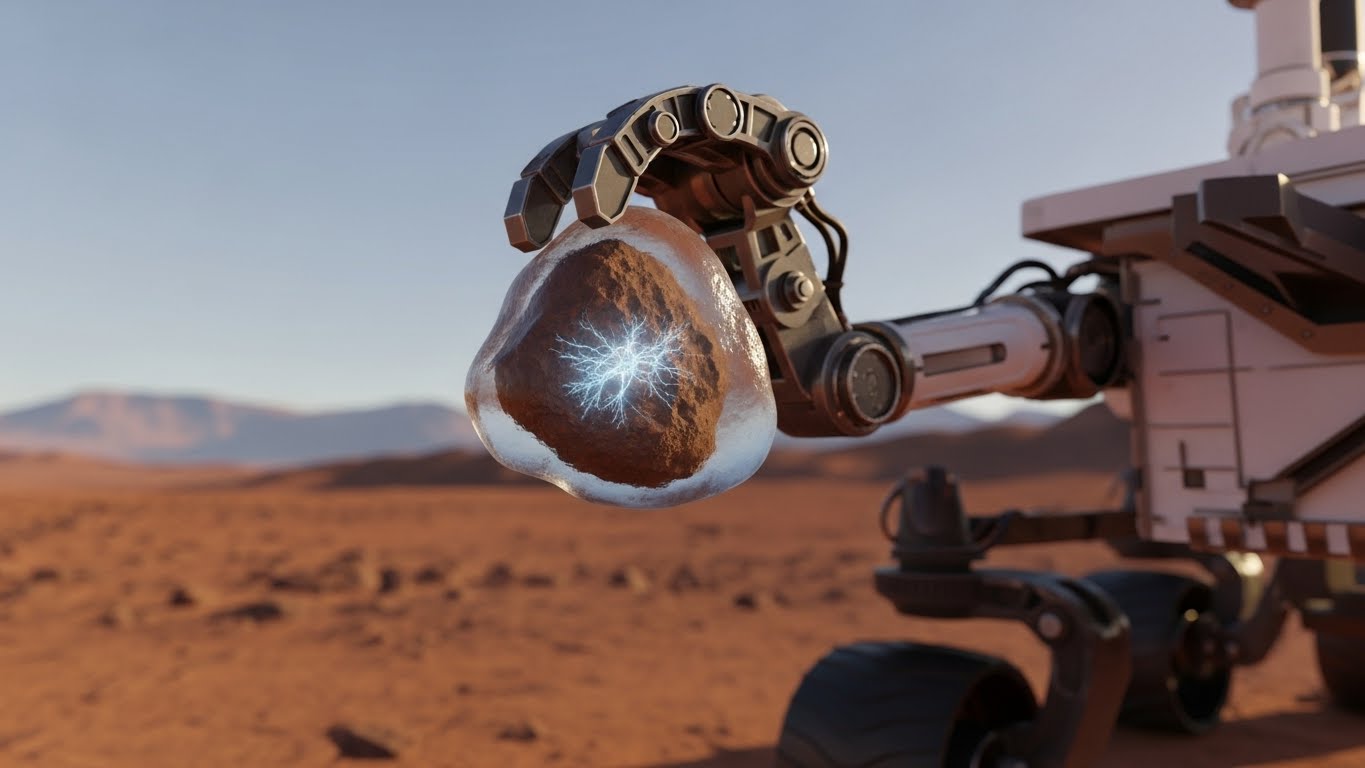
The discovery of microbial life on Mars would be the most significant scientific milestone in human history. It would instantly confirm “Biological Universalism”—the theory that life is not unique to Earth. This revelation would force a total rewrite of biology textbooks, ignite a new space race for sample returns, and pose profound philosophical questions about our place in the cosmos.
The Red Planet’s Biggest Secret
For decades, Mars has been a graveyard of robotic explorers looking for a single sign: Water. But water is only the precursor. What if the search for life ends today? If a rover like Perseverance detects metabolic signatures in a Martian core sample, the world as we know it changes in a heartbeat.
The “What If” Scenario: Life Beyond Earth
1. The Scientific Revolution: Biology 2.0 Currently, all biology is based on DNA/RNA.
- What if Martian life has a different genetic code? We would have to invent a new branch of science—Exobiology—to understand how life can evolve in extreme radiation and sub-zero temperatures.
- The “Second Genesis”: If life started independently on two neighboring planets, it means the universe is likely teeming with life.
2. The Colonization Dilemma: Ethics vs. Expansion Elon Musk’s dream of a million-person city on Mars would face a massive legal hurdle.
- Bio-Ethics: If Mars has its own “citizens” (even microbes), do we have the right to contaminate their world with Earth’s bacteria?
- The Quarantine Era: Bringing samples back to Earth would require the highest level of bio-containment ever built. What if a Martian microbe is toxic to Earth’s ecosystem?
3. Philosophical and Religious Impact The discovery would trigger a global identity crisis.
- The Great Reset: Major world religions would need to reconcile their scriptures with the existence of extraterrestrial life.
- Human Unity: For the first time, humanity might stop seeing itself as a collection of nations and start seeing itself as a single planetary species.
The Economic Impact: The New Space Gold Rush
The discovery would lead to a 1,000% increase in NASA and SpaceX funding. Governments would race to be the first to study Martian life, leading to:
- Advanced Biotech: Martian microbes might possess enzymes that could cure Earth-bound diseases or create new forms of renewable energy.
- Terraforming Debates: Should we change Mars to fit humans, or preserve it as a biological sanctuary?
Exploring Mars requires the most advanced AI and cybersecurity systems. Read about the potential risks of AI autonomy in our article on AI Sentience from our TechWhatIf.com.