
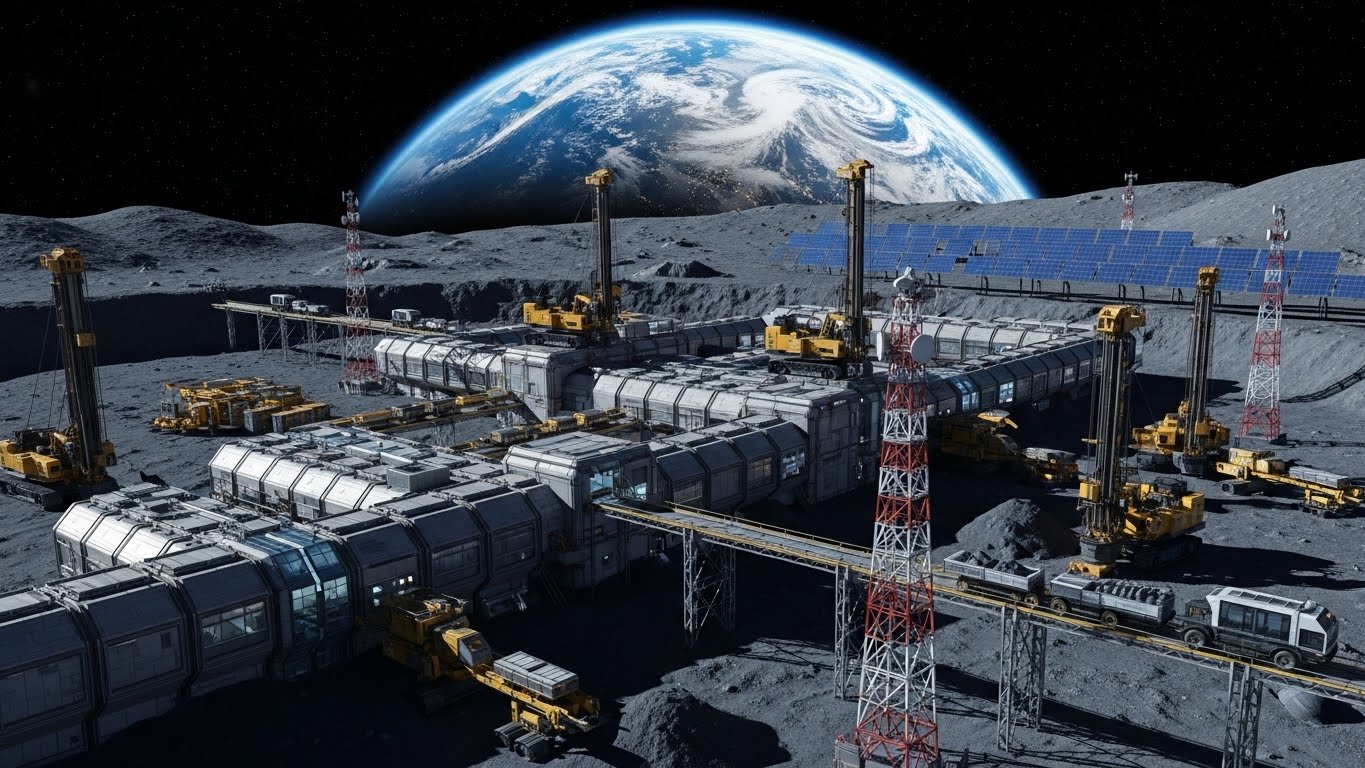
The Moon is no longer just a poetic symbol; it is the next gold mine. With the discovery of Water Ice at the lunar poles and vast deposits of Helium-3, the 2030s are set to become the era of lunar industrialization. What if the Moon becomes a full-scale commercial mining colony? This transition could solve Earth’s energy crisis but might also ignite the first “Cold War” in deep space.
1. The Lunar Gold Rush: Why the Moon?
The Moon contains trillions of dollars worth of resources that are rare on Earth.
- Helium-3: A clean, non-radioactive fuel for future nuclear fusion reactors. Just 25 tons could power the entire United States for a year.
- Rare Earth Metals: Essential for smartphones, EV batteries, and advanced weaponry.
- Water Ice: Located in “Permanently Shadowed Regions,” this ice can be converted into liquid hydrogen and oxygen—the fuel needed to turn the Moon into a “Gas Station” for missions to Mars.
1. The “What If” Scenario: Life in a Corporate Lunar Colony
A. The Rise of “Company Towns” in Space Imagine a world where your employer doesn’t just provide a paycheck, but also your oxygen, water, and protection from radiation.
- The Corporate Sovereignty: What if companies like SpaceX or Blue Origin establish their own laws on the lunar surface? We could see the emergence of “Citadel Colonies” where national laws don’t apply.
- Lunar Labor: Who will do the hard work? We might see a new class of “Extraterrestrial Workers” living in underground lava tubes to escape cosmic rays.
B. Geopolitical Tensions: The New Silk Road
- The Artemis vs. ILRS Divide: The world is already splitting into two camps—one led by the US (Artemis Accords) and the other by China/Russia (International Lunar Research Station).
- Territorial Disputes: The Outer Space Treaty of 1967 forbids any nation from “owning” the Moon. However, what if a country claims “exclusive rights” to a specific crater because they built a mine there? This “De Facto Ownership” could lead to military skirmishes in orbit.
C. The Environmental Impact: Changing the Night Sky
- Lunar Dust & Atmosphere: Massive mining operations would kick up “Regolith” (lunar dust), which could create a permanent, thin atmosphere of dust around the Moon, potentially obscuring our view from Earth.
- The Ethical Question: Do we have the right to strip-mine another celestial body? Or should the Moon be preserved as a “Global Wilderness”?
A Mirror to Our Greed?
“In my opinion, mining the Moon is a necessary evil if we want to become a multi-planetary species. From TechWhatIf’s perspective, we cannot reach Mars or the asteroid belt if we keep hauling every liter of fuel from Earth’s deep gravity well. However, my heart aches for the ‘Starlit Night.’ If the Moon becomes an industrial zone, we risk turning our beautiful satellite into a glowing construction site. We must decide now: is the Moon a ‘Sacred Sanctuary’ or just another resource to be consumed by the 1%? History suggests we will choose the latter, unless we build a ‘United Nations of Space’ that actually has teeth.”
Recommended Reading
The resources mined on the Moon will likely be traded using digital currencies. Read our analysis on What If Bitcoin Hits $1 Million: The Geopolitical Fallout to see how the future economy will handle extraterrestrial wealth.
Note: This is a speculative ‘What If’ analysis and not financial or investment advice. Lunar mining involves high-risk engineering and complex international law; always perform your own due diligence.