
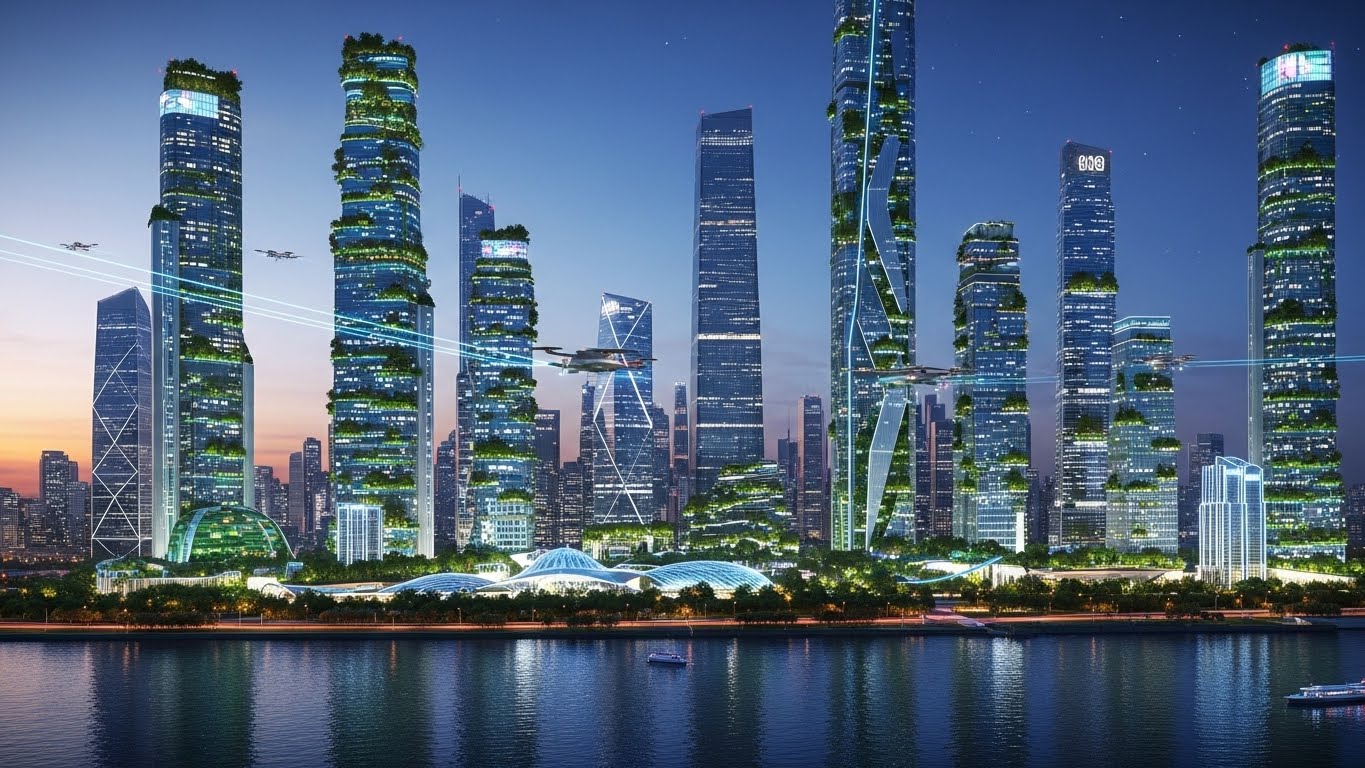
For 12,000 years, human civilization has relied on horizontal expansion—clearing forests to plant crops. But by January 2026, with climate unpredictability and a global population hitting new peaks, the “flat farm” is under threat. What if vertical farming—growing crops in stacked layers inside controlled urban environments—replaces traditional agriculture? This shift could save the planet’s biodiversity but might also turn food production into a high-tech monopoly.
1. The Architecture of Food: Farming Up, Not Out
Vertical farms use LED lighting, hydroponics, and AI to create the “perfect” environment for plants 24/7, regardless of the weather outside.
- Efficiency: A 1-acre vertical farm can produce the same yield as 10–20 acres of traditional soil-based farming.
- Resource Saving: These systems use 95% less water than traditional farms by recycling every drop within a closed-loop system.
2. The “What If” Scenario: From Fields to Skyscrapers
A. The Re-Wilding of Earth If we no longer need millions of hectares for corn and soy, what happens to the land?
- Nature Returns: Massive portions of the Midwest or the Amazon could be “re-wilded,” allowing forests to grow back and absorb trillions of tons of CO2.
- Urban Self-Sufficiency: Cities like Phnom Penh or New York could grow 80% of their own fresh produce on-site, eliminating the need for long-distance shipping and reducing carbon footprints.
B. The Economic Disruption: The End of the “Farmer”
- Job Shift: Traditional farmers might become “Urban Bio-Engineers.” However, those who cannot afford the high-tech sensors and AI software may be forced out of business.
- Energy Dependency: What if a massive power grid failure occurs? Unlike a traditional farm, a vertical farm without electricity dies in hours. Food security would become entirely dependent on a stable energy supply.
C. The Taste and Nutrition Debate
- Precision Nutrition: We could “program” vegetables to have 10x more vitamins or specific flavors.
- The “Soul” of Food: Will we miss the seasonal taste of a sun-ripened mango? What happens to the culture of cooking when food is grown in a sterile, lab-like environment?
The Greenhouse Earth
“In my opinion, vertical farming is the only way to feed a world of 10 billion people without destroying our remaining forests. From TechWhatIf’s perspective, it’s about ‘Decoupling’—separating human survival from environmental destruction. However, we must ensure that ‘Food Data’ doesn’t become a corporate secret. Everyone should have the right to the algorithms that grow our food. We don’t want a future where a software update determines who eats and who starves.”
Recommended Reading
Modern agriculture requires precise management of resources. Read our analysis on What If Personal Carbon Credits Become a Global Currency? to see how every vegetable you eat—whether from a field or a skyscraper—might soon impact your digital wallet.
Note: This is a speculative ‘What If’ analysis based on current 2026 advancements in AgTech. While vertical farming is growing for leafy greens, many staple crops like wheat and rice still face economic challenges in vertical environments.