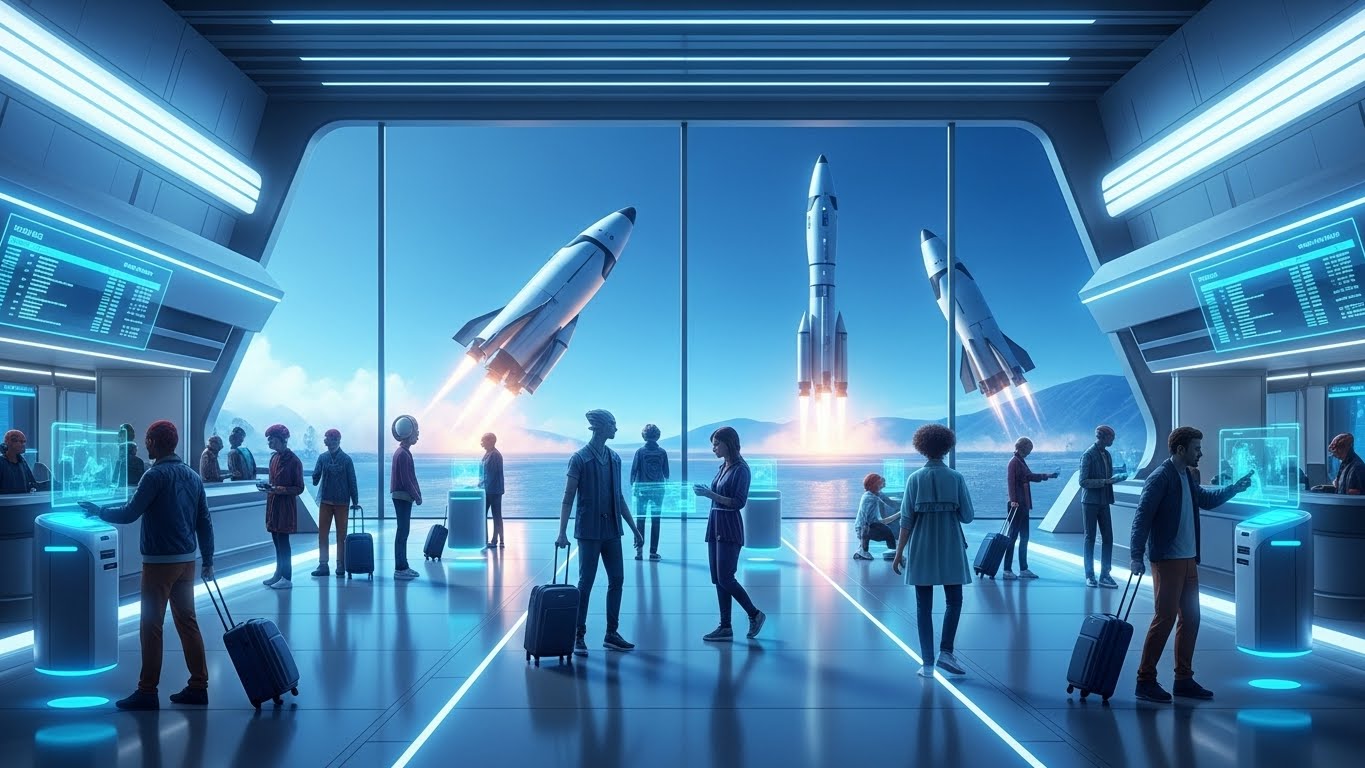
The vision of space tourism as a luxury only for billionaires may soon be obsolete. By 2035, driven by reusable rocket technology like SpaceX’s Starship and aggressive market competition, the cost of a sub-orbital or even orbital flight could drop significantly. While current sub-orbital trips cost around $450,000, projections suggest they could fall to $100,000 or even lower as the industry scales. This “What If” scenario would trigger a seismic shift in global travel and force humanity to confront the environmental and ethical implications of widespread space access.
The Final Frontier: Now Accessible to the “High-Net-Worth” Middle Class
For centuries, space travel has been the exclusive domain of astronauts. Today, the “rebound effect” of reusable rockets is driving down costs from $18,000/kg (Shuttle era) to roughly $2,700/kg today, with Starship aiming for $100/kg. What if this trend accelerates? If a ticket to orbit becomes comparable to a high-end luxury vacation, the economic and spiritual implications would be profound. We are moving from “if we can go” to “when we can afford to stay.”
The “What If” Scenario: Earth as a Museum vs. The Orbital Junkyard
A. The Tourism Boom & The “Overview Effect”
If space becomes accessible, travel priorities will shift.
- The Orbital View: What if everyone wants to see Earth from above? The sheer volume of people experiencing weightlessness would create a new type of mass tourism.
- The Luxury of Earth: Paradoxically, visiting pristine natural sites on Earth might become the new ultimate luxury, as seeing the planet from space becomes commonplace.
B. Environmental Concerns: The Carbon & Soot Reality
Increased rocket launches come with a heavy cost that is often overlooked.
- The Soot Footprint: While a rocket emits a fraction of an airplane’s $CO_2$, it releases hundreds of times more black carbon (soot) into the stratosphere, where it can stay for 4 years, warming the air 500 times more effectively than at lower altitudes.
- The Ozone Threat: Routine launches could undermine the recovery of the ozone layer, particularly over Antarctica, due to nitrogen oxides and water vapor spewed at high altitudes.
C. Geopolitical Shifts: Spaceports as the New Airports
- The New Hubs: Countries with tropical coasts (ideal for launches) will become global travel hubs.
- The Kessler Syndrome: More launches increase the risk of a “cascade of collisions,” potentially rendering key orbits unusable for everyone.
Is the “Overview Effect” Worth the Climate Cost?
“In my opinion, the idea of a $2,000 ticket to space is a thrilling dream but an environmental nightmare. From TechWhatIf’s perspective, we are at a crossroads: do we democratize the ‘Overview Effect’—the life-changing realization of Earth’s fragility—at the cost of actually damaging that very atmosphere? I believe the 2030s will be defined by a ‘Space Tax’ similar to carbon credits. We shouldn’t just ask if we can make space travel cheap; we must ask if we can make it clean. A ‘cheap’ flight to orbit isn’t a bargain if it costs us our ozone layer.”
Recommended Reading
As space becomes more accessible, the question of life beyond Earth becomes even more pressing. Read our article What If We Find Microbial Life on Mars This Year? to understand the implications of extraterrestrial discovery.
Note: This is a speculative ‘What If’ analysis and not financial advice. Always perform your own research and consult with a professional financial advisor before making any investment decisions. The content on TechWhatIf.com is for educational and entertainment purposes only.